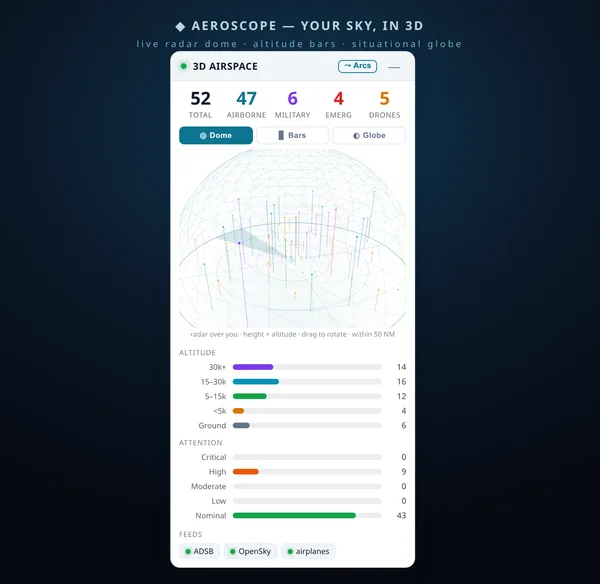
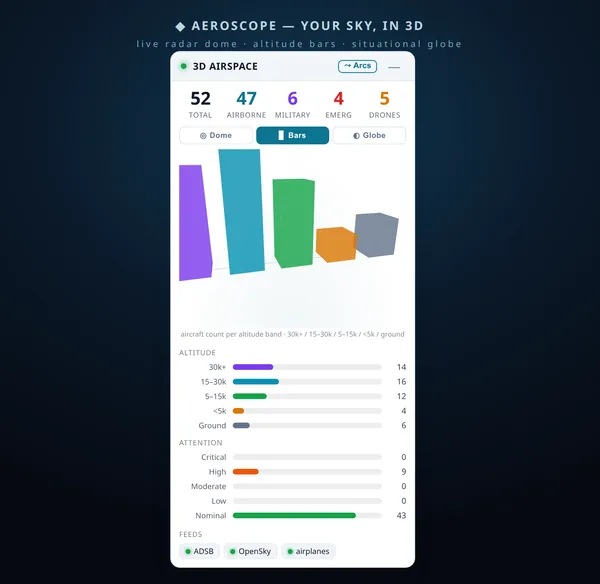
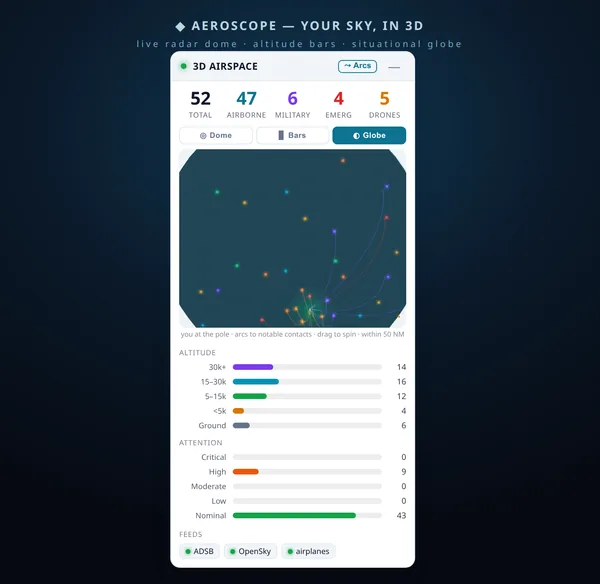
AeroScope uses ADS-B data, behavioral heuristics, and Remote ID protocols to detect and track unmanned aerial vehicles in real-time. Identify drone activity, assess threat levels, and monitor restricted airspace with confidence scoring and automated alerts.
The rapid proliferation of consumer and commercial drones has created a significant airspace management challenge. Over 1 million drones are registered with the FAA in the United States alone, and many more operate unregistered. Unlike manned aircraft that carry Mode S transponders, most small drones do not broadcast ADS-B signals, making them invisible to traditional surveillance systems.
The threat landscape includes unauthorized flights near airports, prisons, critical infrastructure, and military installations. In 2023, the FAA received over 3,000 drone sighting reports from pilots, a number that continues to grow each year. Effective drone detection requires a multi-layered approach combining passive RF monitoring, ADS-B/Remote ID ingestion, and behavioral analysis of radar-like tracks.
AeroScope's drone detection engine operates as a multi-stage pipeline that analyzes every aircraft in the monitored airspace. The system does not rely on a single indicator — instead, it combines dozens of behavioral and data-driven signals into a composite drone confidence score.
Low altitude (below 1,000 ft AGL), slow ground speed (under 100 kts), frequent heading changes, hover behavior, and loiter/orbit patterns are strong indicators of drone activity. AeroScope's pattern-of-life engine detects orbit, racetrack, and spiral flight profiles that are characteristic of surveillance or mapping drones.
Drones often lack standard Mode S extended squitter data. Missing or unusual callsigns, ICAO hex addresses outside assigned national blocks, absence of NIC/NAC integrity values, and non-standard category codes all contribute to the drone score. Military-flagged UAVs are identified separately via dbFlags.
FAA Remote ID broadcasts include serial number, operator location, velocity, altitude, and timestamp. AeroScope ingests Remote ID data from compatible ground receivers and correlates it with ADS-B tracks to provide positive drone identification with operator position mapping.
Every aircraft processed by AeroScope receives a drone confidence score from 0 to 100. The scoring algorithm evaluates multiple weighted indicators and produces a composite assessment.
| Indicator | Weight | Description |
|---|---|---|
| Low Altitude | +20 | Aircraft below 1,000 ft AGL. Below 400 ft adds an additional +10 bonus (FAA drone ceiling). |
| Slow Speed | +15 | Ground speed below 100 kts. Below 50 kts adds +10. Stationary/hover adds +15. |
| No Callsign | +10 | Missing or blank flight/callsign field in ADS-B data. |
| Unusual ICAO Hex | +10 | ICAO 24-bit address outside known national assignment blocks. |
| Loiter Pattern | +15 | Circular, racetrack, or orbit flight pattern detected by pattern-of-life engine. |
| No Extended Squitter | +10 | Missing NIC, NAC, SIL, or other Mode S integrity fields. |
| Erratic Heading | +10 | Frequent heading changes (>30 degrees per update cycle). |
| Remote ID Match | +30 | Positive match with a Remote ID broadcast (definitive identification). |
The FAA's Remote ID rule (14 CFR Part 89), effective September 16, 2023, requires most drones weighing over 0.55 lbs (250g) to broadcast identification and location data during flight. This is often called "a digital license plate for drones."
Remote ID data is transmitted via Bluetooth 4.0/5.0 LE and Wi-Fi Neighbor Awareness Networking (NAN). The effective range is typically 300-500 meters for Bluetooth and up to 1 km for Wi-Fi. AeroScope ground receivers can capture these signals and correlate them with ADS-B data for comprehensive drone tracking.
Monitor the critical safety zones around airports for unauthorized drone activity. AeroScope's geofencing engine can define exclusion zones matching FAA Part 107 airspace restrictions. Any drone candidate entering these zones triggers immediate alerts via WebSocket, email, and webhook.
Power plants, water treatment facilities, government buildings, and data centers are all potential drone surveillance targets. AeroScope provides 24/7 automated monitoring with configurable alert thresholds and historical pattern analysis to detect repeated reconnaissance flights.
Large public events, stadiums, and outdoor venues need real-time drone detection. AeroScope can define temporary geofences around event perimeters and alert security teams when drone candidates are detected, with confidence scoring to reduce false positives.
Military installations and law enforcement operations require reliable drone detection with low false-alarm rates. AeroScope's multi-indicator scoring system and pattern-of-life analysis provide the signal fidelity needed for operational decision-making.
Access drone detection data programmatically through the AeroScope REST API. The /api/drones endpoint returns all current drone candidates with full scoring details.
| Endpoint | Method | Description |
|---|---|---|
/api/drones |
GET | Returns all current drone candidates with confidence scores, indicators, and flight data. |
/api/aircraft?maxAlt=1000 |
GET | Filter all aircraft below 1,000 ft — useful for low-altitude surveillance. |
/api/patterns |
GET | Get pattern-of-life analysis including orbit/loiter detection relevant to drone behavior. |
/api/geofences |
POST | Create geofence exclusion zones with automatic drone alerts on enter/exit. |
Yes. While most consumer drones do not carry ADS-B transponders, larger commercial drones and those complying with FAA Remote ID rules do broadcast on 1090 MHz or via Bluetooth/Wi-Fi. AeroScope also uses behavioral heuristics to flag probable drone activity even without a direct transponder signal.
Remote ID is an FAA mandate effective September 2023 requiring most drones weighing over 0.55 lbs (250g) to broadcast identification and location data. Drones must transmit their serial number or session ID, position, velocity, operator location, and timestamp.
AeroScope assigns a drone confidence score (0-100) based on multiple indicators: altitude below 1,000 ft AGL, ground speed below 100 kts, no registered callsign, ICAO hex in unassigned ranges, erratic heading changes, loiter patterns, and lack of Mode S extended data. A score above 70 is flagged HIGH confidence.
DJI drones with Remote ID modules broadcast their position over Wi-Fi and Bluetooth. AeroScope can detect these when paired with a compatible ground receiver. For DJI drones without Remote ID, behavioral detection heuristics are used to flag suspicious targets.